
Zionsville City Directory Holdings
Zionsville does not have a continuously searchable city directory database documented in the research. Its historical trail is strongest when local and county collections are combined. The coverage table distinguishes a named run from a repository that reports directories or phone books without publishing a full title-by-title list.
| Collection | Years | Where held | Access |
|---|---|---|---|
| Zionsville city directories and phone books | Years not fully listed online | SullivanMunce Cultural Center | Call, visit, limited online scans |
| Lebanon and county-seat directories | 1893-2004, with gaps | Lebanon Public Library Heritage Center | Local history collection |
| Boone County phone books | 1916-2020 | Lebanon Heritage Center | In person or staff inquiry |
| State Library directory list | 1900-01 through 1998/99, selected years | Indiana State Library | Guide, library reference, microfilm or print |
| Newspapers and state indexes | Collection-specific | Hussey-Mayfield Digital Branch | Online, cardholder, or in-library access |
The Lebanon Heritage Center lists 1893, 1900, 1905, 1908, 1910, 1916, 1920, 1922, 1924, 1926, 1930, 1936, 1939, 1942, 1946, 1949, 1953, 1956, 1959, 1961, 1963, 1966, 1968, 1971, 1972, 1974, 1976, 1978, 1980, 1982, 1984, 1986, 1988, 1990, 1992, 1994, 1998, and 2004. Ask whether a given volume covers Zionsville before treating the list as a local run.
Zionsville City Directory Coverage Gaps
The Indiana State Library city directory guide lists Lebanon, not a separate Zionsville title, in its Boone County PDF. That absence is a useful limit, but it does not prove no Zionsville directory exists. SullivanMunce reports city directories and phone books, and a local catalog may describe a volume differently.
The State Library list includes Longwell & Cumming's 1900-01 Lebanon Directory, Indiana Directory Co. in 1905, W.H. Hoffman volumes in 1920 and 1928, and selected later years through 1998/99. The official guide appears below.
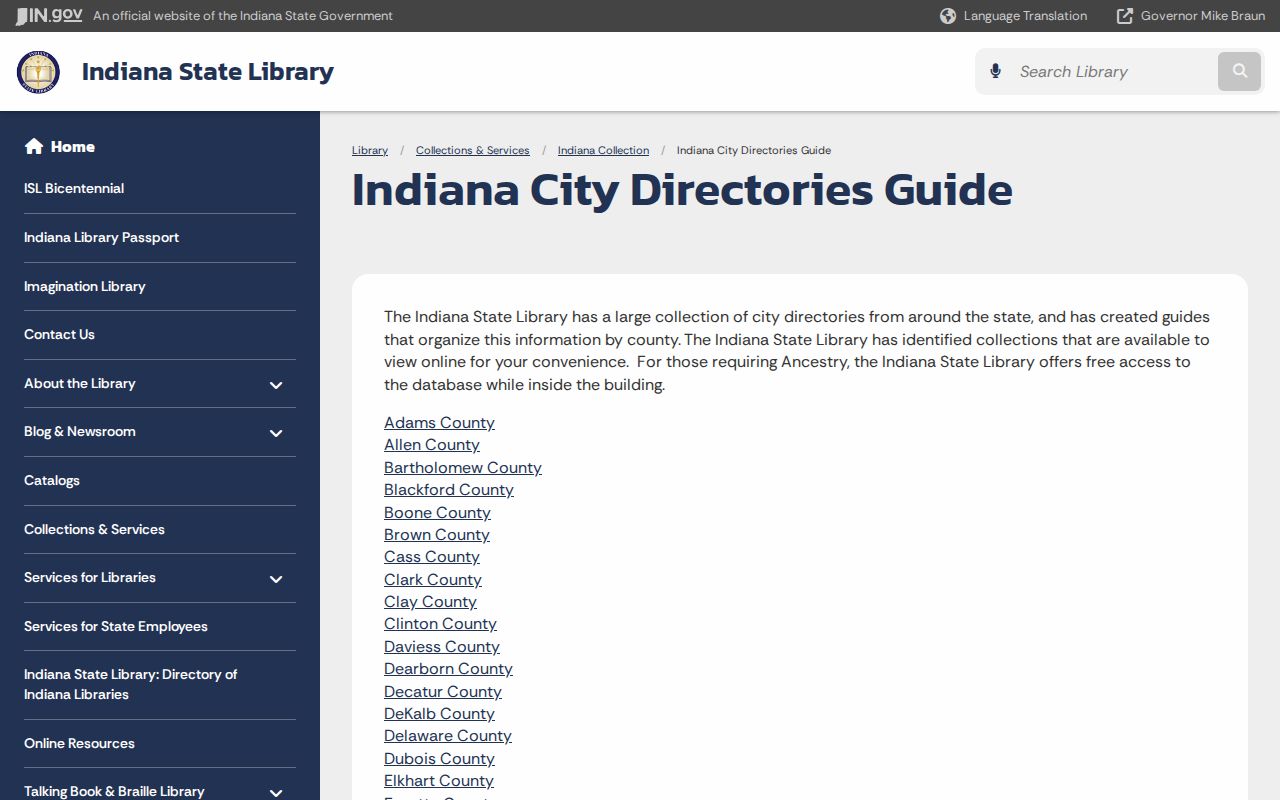
The image shows the authoritative state entry point. Search its county list, then verify the title, geographic scope, year, and holding before recording a person from it.
Try several catalog terms: “Zionsville,” “Eagle Township,” “Boone County,” “Lebanon,” and an old street name. A modern ZIP alone can hide records created before current postal labels.
Zionsville Directories at SullivanMunce
SullivanMunce Cultural Center is the most specific local history stop. Its genealogy center reports more than 4,000 volumes, while the databases description says approximately 5,000 volumes. The holdings cover Eagle Township families, firms, churches, schools, homes, parks, and service groups, along with surname files, land, census, wills, maps, newspapers, obituaries, yearbooks, city directories, and phone books.
The center at 225 W Hawthorne Street is free and can be reached at 317-873-4900. It is a FamilySearch Affiliate Library, with Ancestry and Newspapers.com available on site. Its online historical collection is only part of the full holdings, and new scans are added over time. Call ahead when a fragile book, microfilm reel, or staff search is needed.
Research policies list a one-dollar obituary search when an exact death date is supplied, plus copying, and twenty-five dollars per hour for extensive research over thirty minutes. Copies are listed at fifty cents per page, though fragile material may not be copied. Recheck all fees before ordering.
Boone Directories Near Zionsville
The Lebanon Public Library Heritage Center supplies the fullest published year list in the research. Its directories and long phone-book run can fill gaps around census decades, identify a surname spelling, or show county business and telephone context. Coverage still needs inspection page by page because a Lebanon title may not include every Zionsville household.
The Heritage Center source pictured below is the right place to confirm local-history access and ask which volumes extend beyond Lebanon.
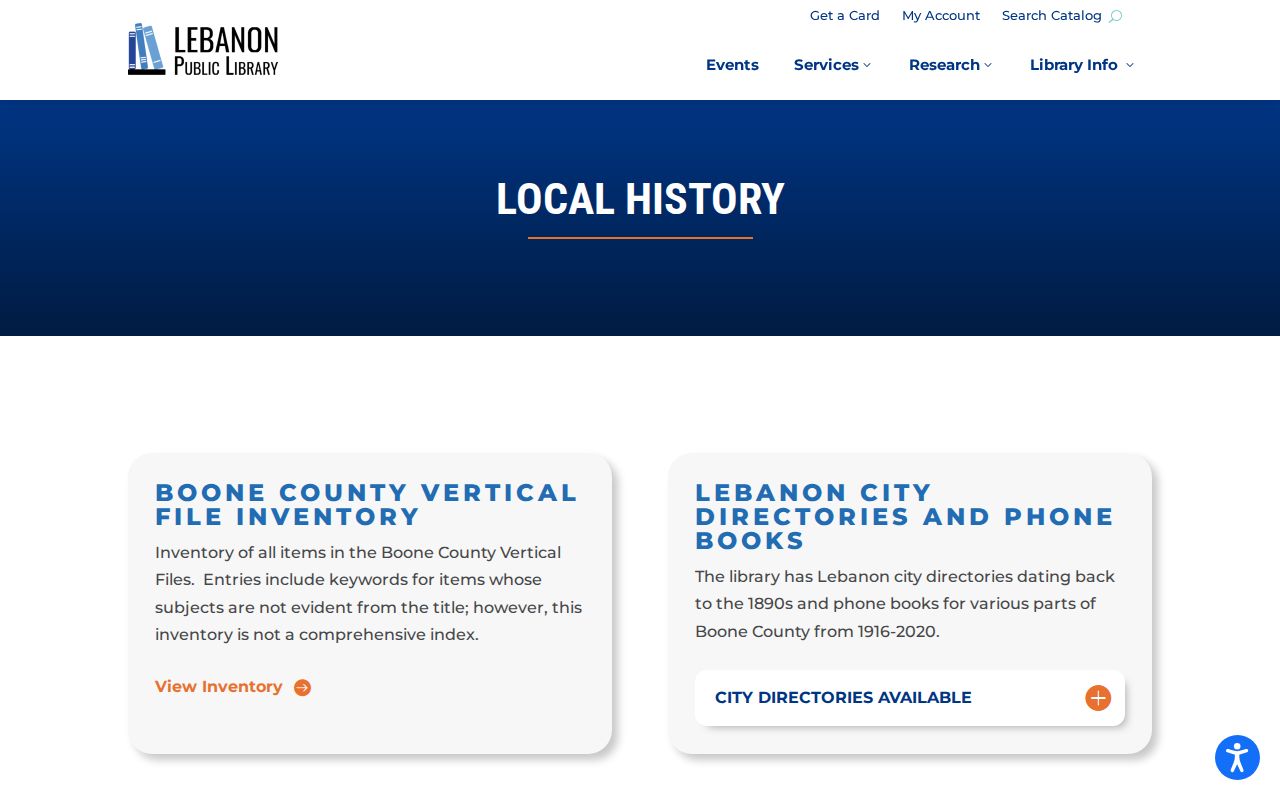
The screenshot connects the year list to its repository. Staff can help distinguish a directory, a telephone book, an index, and a county history before a visit.
Boone County Historical Society is an appointment-based fallback for originals and local context. Its holdings should be treated as research material, not as a certified public record.
Read a Zionsville Directory Entry
Transcribe what the page says, including the year, page, exact spelling, abbreviations, and geographic scope. Do not import modern meanings into an old notation. A city directory entry may name a householder, spouse, occupation, firm, and street address, but actual fields vary by publisher and year.
| Name | Exact printed form, initials, and surname spelling |
|---|---|
| Spouse or status | Only when the entry prints it; widow notation can connect another name |
| Occupation or firm | A dated work or business clue, not a full life history |
| Address | Residence or business address as labeled in that volume |
| Symbols | Owner, renter, boards, residence, or other marks defined by that edition |
| Citation | Title, publisher, year, page, repository, and call number when available |
Photograph the abbreviation key if copying is allowed. It controls the meaning of short forms. If a surname is missing, check spelling variants, initials, spouse names, firms, and the address index.
- Criss-cross directory
- A volume arranged by street address or phone number, useful when the place is known first.
- Householder index
- An alphabetical list centered on the person identified as head of a household.
- Abbreviation key
- The publisher's own legend for occupation, address, marital, and ownership marks.
- Index
- A finding tool that points to an entry; it is not a substitute for the underlying page.
Digital Sources for Zionsville Names
Hussey-Mayfield Memorial Public Library's Digital Branch lists History Reference Source, Hoosier State Chronicles, Indiana Legacy, Indiana Memory, Census.gov, and INSPIRE. These are companion sources when the directory year is absent or an entry needs support. Some require a library card or in-library use.
Hoosier State Chronicles is described by the library as a searchable newspaper collection with more than 120,000 digitized issues. Indiana Legacy supports searches across Indiana birth, marriage, death, and divorce material, but access and coverage vary. A newspaper may explain an address or family event; it does not automatically correct the printed directory.
Researchers who need help with catalog or database access can request a Book-a-Librarian appointment. Sessions are listed at thirty to sixty minutes. The intake asks for contact details, a topic, and notes. Staff can guide database use, but a library cannot certify a government record.
Map Zionsville Directory Addresses
Old address work needs a date. Zionsville's 1935 street-renaming table changed Water to Elm, Meridian to Main, Center to Hawthorne, South to Oak, Station or Depot to Cedar, and many numbered street names. A directory printed before that change may be correct even when the street does not match today's map.
The Indiana State Library Sanborn list gives five Zionsville editions: 1895, 1902, 1910, 1922, and 1939. Those snapshots straddle the rename and can show footprints, use, construction clues, and street context.
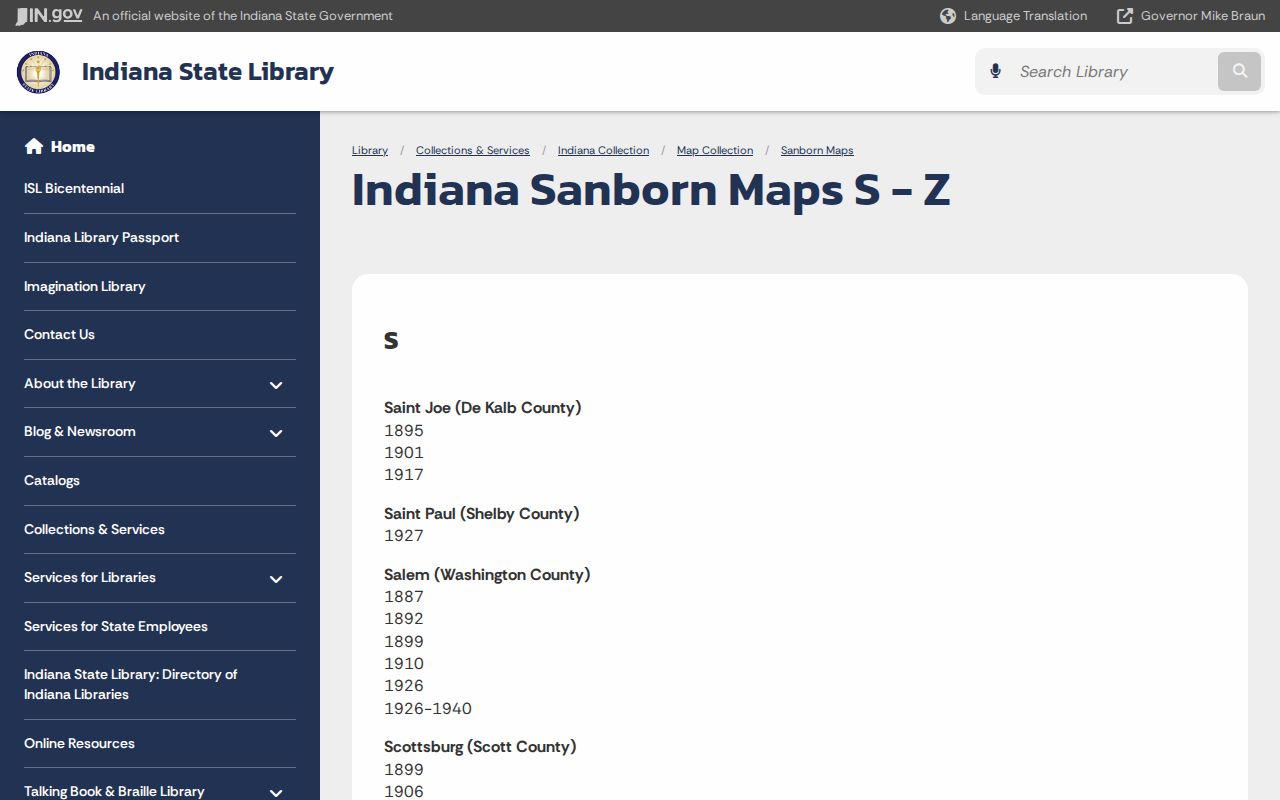
The displayed year list is the reliable starting point because a direct Library of Congress Zionsville item identifier was not found. Pair the chosen sheet with the directory year and legal lot description.
Note: The 1939 Sanborn edition is the first listed set after the 1935 street changes, making it a key address translation check.
Zionsville Directory Research Timeline
Different eras leave different kinds of evidence. The timeline below prevents a search from demanding a printed directory where the documented collections instead point to land, newspaper, or archival sources.
| Period | Best route | Main caution |
|---|---|---|
| 1830-1855 | Land, court, marriage, probate, church, newspaper, archives | The 1856 fire destroyed much county material |
| 1856-1900 | Recorder books, abstracts, Sanborn, census, local histories | Legal descriptions may replace street addresses |
| 1893-1928 | Lebanon directories and county phone context | No separate Zionsville run appears in the State Library list |
| 1930-1959 | Directories, local newspaper microfilm, Sanborn, surname files | Check title scope and 1935 street names |
| 1960-2004 | Lebanon directories and local phone books | Confirm Zionsville inclusion for each volume |
| 2005-2020 | Boone County phone books and library files | Printed lists are incomplete and dated |
The 1856 fire is a major break. Later “Heretofore Recorded Deeds,” family abstracts, newspapers, and court material may preserve a name lost from the original county books. An empty directory search before the fire should open a new source path, not end the inquiry.
Zionsville Records Beyond Directories
A proposed Boone County Clerk digitization project described sixty-five physical books and about 45,500 images. Completion was not verified in the research, so do not promise online access. Ask the Clerk whether the relevant book has been scanned and whether inspection, a paper copy, or a certified copy is available.
This proposal matters to family research because court and marriage materials can test a relationship suggested by a city directory. The Boone County Clerk is at 212 Courthouse Square in Lebanon and can be reached at 765-482-3510. State historical fallbacks include the Indiana State Library and Indiana State Archives.
A directory, newspaper, court index, and deed each describe a different role. Agreement among them strengthens a timeline, while a conflict should be preserved and explained by date, spelling, jurisdiction, or source type.
Trace Zionsville Families by Directory
Follow a household in small steps. Never assume that a missing year means death or departure. The person may be omitted, unlisted, spelled differently, outside the title's boundary, or represented under another householder.
- Choose the earliest likely directory year and record the full title and coverage area.
- Search the surname, initials, spouse, occupation, firm, and old street name.
- Copy the exact entry with page number and the publisher's abbreviation key.
- Move forward and backward through available years, noting each address or household change.
- Pair entries near 1900, 1910, 1920, and later decades with the matching census when available.
- Test the trail against newspapers, obituaries, cemetery files, deeds, maps, and family papers.
If an address becomes the main question, the modern parcel and deed method belongs in the Zionsville street directory. For historical work, keep the city directory citation at the center and use each companion record to confirm one fact.
SullivanMunce's historic-house guide gives a good model. It reports nearly fifty abstracts and an Oliver Addition Lot 37 example with a thirty-five-dollar sale in 1860 and a three-hundred-dollar sale in 1862. The price shift may suggest a change, but it does not prove that a house was built. The original deed, map, directory, and newspaper evidence must carry that conclusion.